Tracking ticket price history for concerts is the process of accessing past and current pricing data to identify the best moment to buy, and it can save you hundreds of dollars on a single show. Concert ticket prices rose 80.5% between 2021 and 2025, outpacing general inflation by four times. That kind of market movement makes price monitoring a practical skill, not a luxury. Tools like TicketData, Event Spy, and SeatGeek now make it possible to pull up months of pricing data before you ever open your wallet. This guide covers the best platforms, how to read price trends, and how to set up alerts that actually catch real deals.
What tools let you track ticket price history for concerts?
The right platform turns raw resale data into a clear picture of where prices have been and where they are heading. Four tools stand out for concert-goers who want genuine historical price data rather than a single snapshot.
TicketData is purpose-built for this task. It aggregates price trends across sports and concerts, charting historical values down to specific seat zones. Building that seat-level accuracy requires extensive data cleaning because venue sections are named inconsistently across platforms. The result is one of the most granular free tools available for concert ticket price analysis.

Event Spy focuses on price drop alerts. You set a target price for a specific event, and the platform notifies you when listings hit that threshold. It covers major resale markets and is particularly useful for festivals where prices swing widely in the weeks before the event.
SeatGeek offers a built-in Deal Score that grades each listing against historical prices for that event and section. Its data collection relies on automated price monitoring that uses technical solutions to gather comprehensive market data continuously. SeatGeek also shows a price history graph on many event pages, which gives you a quick visual read on whether today’s price is high or low relative to recent weeks.
TickPick displays all-in pricing by default, which removes the guesswork around fees. It does not charge buyer fees, and its price history feature lets you compare current listings against past sold prices for the same event.
| Tool | Price history | Alerts | All-in pricing | Best for |
|---|---|---|---|---|
| TicketData | Yes, seat-level | No | No | Deep historical analysis |
| Event Spy | Yes | Yes | No | Price drop notifications |
| SeatGeek | Yes, visual graph | Yes | No | Quick deal scoring |
| TickPick | Yes | Yes | Yes | Fee-transparent buying |
Pro Tip: Use TicketData for your initial research to understand the price floor for a specific section, then set a TickPick or Event Spy alert at that floor price. You get the depth of one tool and the automation of another.
How to interpret concert ticket price trends and historical data
Reading a price history graph is straightforward once you know what the patterns mean. The “get-in price” is the lowest available listing at any given moment. Watching how that number moves over time tells you whether the market is tightening or loosening.
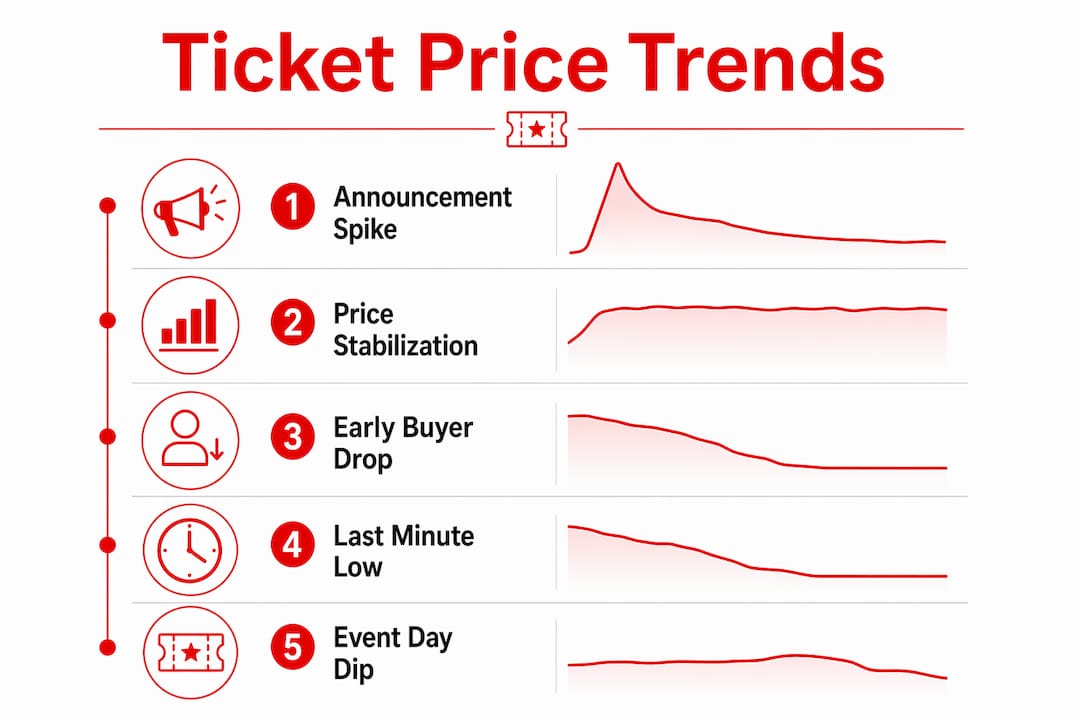
Most concerts follow a predictable arc. Prices spike immediately after an artist announces a tour, then stabilize as the initial frenzy fades. They often dip in the middle window, roughly four to eight weeks before the show, as casual resellers list tickets they no longer need. Then prices either surge again if the show is close to selling out, or they drop sharply in the final days if supply still exceeds demand.
The timing data is striking. Resale tickets purchased on the day of a concert average 33% below the mean price, and buying about 13 days before a festival saves roughly 30%. That does not mean waiting is always the right call. A sold-out arena show will not drop. The historical data tells you which scenario you are in.
| Time before concert | Typical price movement | Strategy |
|---|---|---|
| Day of announcement | Peak prices, high demand | Avoid unless you must attend |
| 4 to 8 weeks out | Moderate, often stable | Good window to monitor |
| 13 days before | Festival prices often drop ~30% | Strong buying window for festivals |
| Day of show | Resale averages 33% below mean | Best for flexible buyers |
Several factors push prices outside these norms. Venue capacity is the biggest lever. A 2,000-seat theater for a popular artist will hold value far longer than a 20,000-seat arena. Day of week matters too. Weekend shows carry a premium over Tuesday or Wednesday dates for the same tour. Geographic demand also plays a role. Regional isolation and infrequent tours create a FOMO economy in markets like Australia, where pent-up demand inflates prices well above what you would see in cities on a regular tour circuit.
Pro Tip: When you see a price that looks unusually low on a history graph, check whether it coincides with a bad weather forecast, a competing local event, or a mid-week date. Context explains outliers better than the number alone.
How to set up concert ticket price alerts step by step
Setting up alerts takes less than ten minutes and removes the need to check prices manually every day. Here is the process across the major platforms.
- Create a free account on TicketData, Event Spy, or SeatGeek. All three offer free tiers that cover the core alert functionality most fans need.
- Search for your event by artist name, venue, or city. Confirm you have the right date and location before saving anything.
- Review the price history graph before setting your alert threshold. Set your target price at or slightly above the historical floor for your preferred section, not at the current listing price.
- Set your alert parameters. Most platforms let you filter by section, row range, and quantity. Specify the number of tickets you need so you do not get alerts for single seats when you need four together.
- Choose your notification method. Email works for non-urgent tracking. Push notifications through a mobile app are better if you are watching a show that could sell out quickly.
- Review and refine after the first week. If you are receiving dozens of alerts daily, your threshold is too broad. Tighten the price range or add section filters. If you receive nothing, your target price may be below what the market will realistically reach.
A few common issues are worth knowing in advance. Alerts sometimes lag by 30 to 60 minutes behind live market prices, which matters for fast-moving events. If you miss a drop, check the platform directly rather than assuming the price is gone. Inaccurate data is also a real problem. Seat zone naming inconsistencies across resale platforms mean that a “Floor GA” listing on one site may not match the same label on another. Cross-reference any alert against the actual venue map before buying.
For fans who want to save on concert tickets beyond price tracking alone, combining alerts with flexible date preferences multiplies your options considerably.
Common mistakes when tracking concert ticket prices
Price tracking only works if the data you are reading is accurate and complete. Several common errors lead fans to overpay or miss genuine deals.
Trusting “recently sold” prices at face value is the most frequent mistake. Some resale platforms use phantom or bait listings in their recently sold data to make prices appear higher than the active market supports. Always compare recently sold figures against the current lowest active listing before drawing any conclusions.
Ignoring fees distorts every comparison. Service and processing fees add 20 to 40% to the face price displayed on most platforms. A $90 ticket that becomes $126 after fees is not a deal if the all-in price on TickPick is $105. Always calculate the final checkout price before deciding.
Tracking only one platform gives you a partial picture. Prices vary meaningfully between StubHub, Vivid Seats, TickPick, and SeatGeek for the same event and section. Monitoring two or three sources catches discrepancies that a single-platform view misses.
Skipping legitimacy checks is a costly shortcut. Verified Resale programs on primary platforms protect buyers from fraudulent tickets. When buying from secondary markets, prioritize sellers whose listings carry a verified badge or a money-back guarantee.
Misreading demand signals leads to poor timing decisions. The K-shaped demand curve in live music means stadium shows for top-tier artists hold price floors firmly while smaller venue shows see much wider swings. Applying the same timing strategy to both categories produces inconsistent results.
The single most reliable signal that a price is real: it appears at the same level across at least two independent platforms with fees included. One platform showing a low price is a data point. Two platforms confirming it is a deal.
Pro Tip: Before buying any resale ticket, run a quick search on winVIPtix for verified experience packages and legitimate resale options. Legitimate platforms with guaranteed fulfillment are worth a small premium over unverified listings.
Key takeaways
Tracking historical concert ticket prices is most effective when you combine multiple platforms, understand timing patterns, and account for fees before comparing any two listings.
| Point | Details |
|---|---|
| Use multiple tools | TicketData, SeatGeek, and TickPick together give a fuller price picture than any single platform. |
| Time your purchase strategically | Resale prices average 33% lower on the day of a show and 30% lower 13 days before festivals. |
| Always include fees | Service charges add 20 to 40% to listed prices, so compare all-in totals, not face prices. |
| Verify before buying | Prioritize Verified Resale programs to avoid fraudulent tickets on secondary markets. |
| Watch demand signals | Stadium shows hold price floors; smaller venue shows offer wider windows for savings. |
What years of watching ticket prices actually taught me
The conventional advice is to buy early or wait for last-minute deals. After tracking concert ticket prices across hundreds of events, the honest answer is that neither rule applies universally. The real skill is reading the specific demand profile of each show, not following a generic calendar.
The most useful insight I have found is that fans are making deliberate choices in a polarized market. Stadium-level artists are selling out regardless of price. Mid-tier and emerging artists are where the tracking tools earn their keep. Those are the shows where patience, a well-set alert, and a willingness to buy on a Wednesday instead of a Saturday can cut your cost by a third.
The other thing most guides skip: the emotional cost of waiting. If missing a show would genuinely disappoint you, buy earlier than the data suggests. The 33% last-minute discount means nothing if the show sells out on day two. Price tracking is a tool for informed decisions, not a mandate to always wait. Use the last-minute ticket strategies when the demand data supports them. Trust the historical floor price as your anchor, set your alert, and then let the market come to you.
— The Ticket News
Stay ahead of concert ticket deals with The Ticket News
The Ticket News tracks concert ticket price trends, market shifts, and event announcements so you do not have to monitor a dozen platforms manually.

From major stadium tours to regional festivals like the Bristol Rhythm & Roots Reunion, The Ticket News covers the events that matter to real music fans. The site publishes updated pricing insights, buying windows, and discount ticket guidance across genres and venues. Whether you are planning months ahead or hunting for a deal this weekend, The Ticket News gives you the market context to buy with confidence. Bookmark it, check it before you buy, and stop overpaying for the shows you love.
FAQ
What does it mean to track ticket price history for concerts?
Tracking ticket price history for concerts means monitoring how resale and face-value prices for a specific event have changed over time. Tools like TicketData and SeatGeek display this data as price graphs, helping you identify the best time to buy.
When is the cheapest time to buy concert tickets?
Resale tickets purchased on the day of a show average 33% below the mean price, while festival tickets bought about 13 days out typically cost 30% less. The optimal window depends on whether the show is likely to sell out before then.
Are service fees included in ticket price history data?
Most price history tools display the base listing price without fees. Service and processing fees can add 20 to 40% to the final cost, so always check the all-in total at checkout before comparing prices across platforms.
How do I know if a low ticket price is legitimate?
Cross-reference the price across at least two independent platforms with fees included. Avoid relying solely on “recently sold” data, which some resale sites manipulate. Listings with a Verified Resale badge or a money-back guarantee carry significantly lower fraud risk.
Which free tool is best for checking historical concert ticket prices?
TicketData offers seat-level price history for free and is the strongest option for detailed concert ticket price analysis. SeatGeek’s Deal Score and price history graph are also free and provide a fast visual read on whether a current listing is above or below historical norms.
Leave a Reply