Family discount tickets are special pricing options that reflect the true cost of admitting multiple family members rather than charging each person a full individual rate. These discounts exist because the economics of group attendance, the social value of cultural access, and the business logic of household retention all point toward the same conclusion: per-person pricing overcharges families. Understanding why family discount tickets exist helps you spot the best deals, avoid the traps, and make smarter decisions at the box office.
Why family discount tickets exist: the economic case
Family discount tickets exist because the marginal cost of admitting an additional child at most leisure venues is close to zero. Marginal cost is the expense a venue incurs by letting one more person through the door. At a children’s museum, a theme park, or an outdoor music festival, that cost is essentially nothing. The lights are already on, the staff are already paid, and the stage is already built.
Per-person pricing ignores this reality. When a family of four pays four full ticket prices, the venue collects revenue far above its actual incremental cost. Economists describe this as overcharging relative to true cost structure. Family discount pricing corrects that imbalance by aligning what families pay with what it actually costs to serve them.
“Admitting one more visitor costs the institution essentially nothing.” Gary Winslett’s 2026 analysis makes the economic case for family pricing as the more coherent pricing model in capacity-flexible venues.
The logic does have limits. Family pricing is less appropriate in seat-constrained settings like airplanes or sold-out stadium concerts, where every seat has real scarcity value. In those cases, a child occupies a unit of capacity that another paying customer could fill. The discount shrinks or disappears because the marginal cost is no longer near zero.
Pro Tip: Before assuming a family deal saves money, check the venue’s capacity situation. A family ticket at a half-empty festival is a genuine discount. The same label at a sold-out arena show may offer far less savings.
How do family discount tickets support access and affordability?
Family discount pricing removes a financial barrier that would otherwise keep many families away from cultural events. High per-head ticket prices act as a deterrent, especially for households with three or more children. When the total cost of a family outing reaches several hundred dollars before food and parking, many families simply stay home.
Reduced-price family entry promotes long-term engagement by making museums, galleries, and entertainment venues more accessible. This is not charity. It is a deliberate strategy to widen participation and build audiences that would not otherwise exist. Venues that invest in affordable family pricing see repeat attendance, stronger word-of-mouth, and deeper community ties.
The benefits of family tickets extend beyond the single visit. Children who attend live music events, theater performances, or cultural exhibitions early in life are more likely to become lifelong attendees. Family discounts are part of a long-term strategy to build that habit by removing the cost friction at the most critical stage.
Key reasons family ticket pricing improves access:
- Lower total outlay makes attendance possible for households on tight budgets.
- Predictable pricing lets families plan outings without calculating per-person costs.
- Bundled value reduces the mental friction of deciding whether the outing is “worth it.”
- Repeat visit incentives often come with family memberships, compounding the savings over time.
- Inclusive design at forward-thinking venues covers single-parent households and extended family groups.
In what ways do family discount tickets function as business tools?
Family discount tickets are not just a public service. They are a retention and acquisition mechanism that shifts the selling unit from the individual to the household. When a venue sells a family ticket or membership, it locks in multiple attendees at once. That bundle is much harder to cancel than a single ticket.
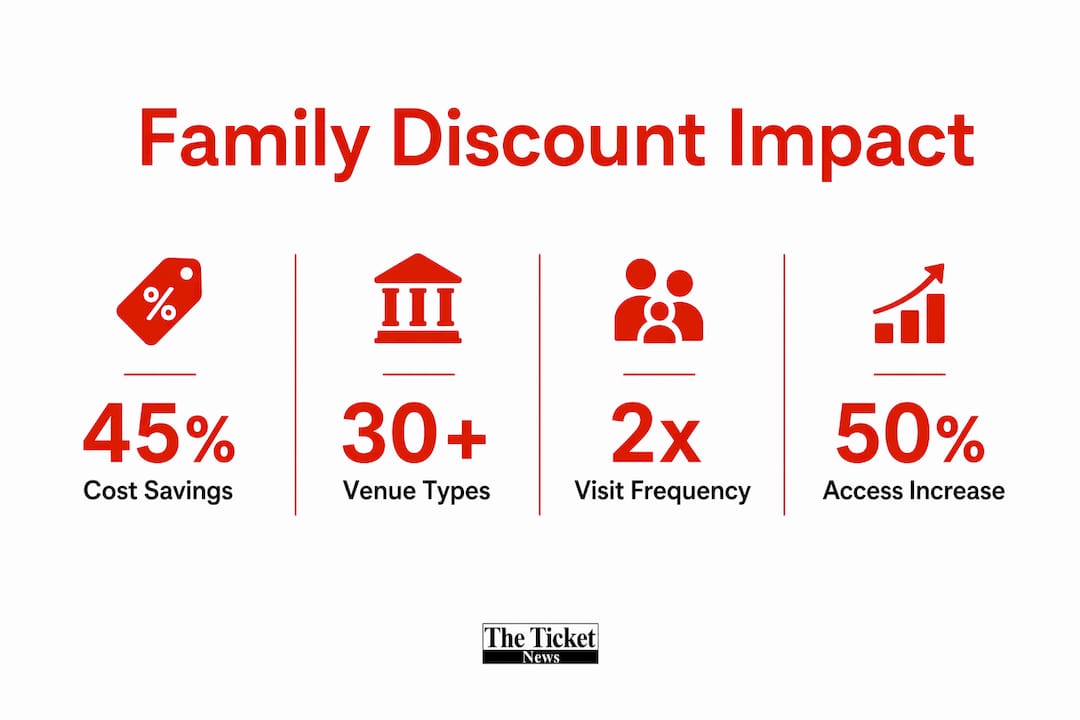
Family and group membership plans make it psychologically and logistically harder for households to walk away. One person in the family might lose interest, but the shared commitment keeps the whole group engaged. This dynamic reduces churn and increases the lifetime value of each customer relationship.
Family plans also function as acquisition levers. A hesitant parent who would never buy an individual ticket may commit when the family bundle lowers the per-person cost to an acceptable level. Family ticket bundles lower friction for the household decision and make pricing simpler to understand.
Here is how venues use family pricing as a business strategy:
- Convert hesitant buyers. A family bundle turns a “maybe” into a “yes” by spreading cost across multiple attendees.
- Increase visit frequency. Families with memberships visit more often because the marginal cost of each visit feels low.
- Generate referrals. Families who feel well-served recommend venues to other families, creating organic growth.
- Build community. Shared family commitments create a sense of belonging that individual tickets never produce.
Pro Tip: If a venue offers both a family day ticket and a family annual membership, calculate the break-even point. Two or three visits often make the membership the better deal, especially for music festivals with multiple events per year.
What operational nuances affect how family discount tickets are designed?
The structure of a family ticket matters as much as the discount itself. Most standard family ticket definitions cover two adults and two children. That structure excludes single-parent households, families with three or more children, and grandparent-led outings. Standard family discounts often exclude single parents or larger family sizes due to rigid eligibility rules.

In cases where children do add meaningful costs, venues often price children at a reduced rate rather than making them free. One proposed model prices children at roughly 25% of the adult rate to balance fairness with revenue needs. This approach, noted by Timothy P. Carney, acknowledges that some marginal costs exist without reverting to full per-person pricing.
| Venue type | Marginal cost per child | Family discount suitability |
|---|---|---|
| Outdoor music festival | Near zero | High |
| Children’s museum | Near zero | High |
| Theater with fixed seating | Moderate | Medium |
| Sold-out arena concert | Full seat value | Low |
| Airplane or transit | Full seat value | Low |
Age restrictions add another layer of complexity. Many family tickets cap children’s eligibility at age 15 or 16, which can exclude older teenagers who still depend on parents financially. Date restrictions, such as weekday-only pricing, further limit usability for working families. The best family ticket designs account for these realities with flexible eligibility and clear, transparent terms.
How can families maximize benefits from family discount tickets?
Getting the most from family ticket pricing requires a few deliberate steps before you buy. The savings are real, but so are the traps. Families should compare deals carefully and check all restrictions before committing.
Practical steps to maximize your savings:
- Compare the family ticket against individual prices. Add up the cost of buying separate tickets for each family member. Some family bundles only save money if you have three or more children.
- Check age limits before you buy. A ticket that covers children under 12 does not help if your youngest is 13.
- Read the date and time restrictions. Many family deals apply only on weekdays or outside peak periods. Confirm the event date qualifies.
- Ask about flexible family definitions. Some venues allow a family ticket to cover one adult and three children, or two adults and three children. Always ask before assuming the standard two-plus-two structure applies.
- Look for family memberships if you plan multiple visits. Annual passes often pay for themselves after two or three outings, especially at music festivals with multi-day programs.
- Use resources like The Ticket News to compare concert ticket discounts across events and find current family deals before prices change.
The group discount principles that apply to concert-goers also apply to families. The more seats you fill in a single transaction, the more negotiating power you have and the better the per-person rate becomes.
Key Takeaways
Family discount tickets exist because per-person pricing overcharges families relative to the near-zero marginal cost of admitting additional children, and venues use these discounts to widen access, reduce churn, and build long-term household relationships.
| Point | Details |
|---|---|
| Marginal cost drives pricing | Admitting an extra child costs most venues almost nothing, making per-person pricing economically unfair. |
| Access is a core goal | Reduced family pricing removes financial barriers and builds lifelong attendance habits in children. |
| Retention is a business benefit | Household bundles are harder to cancel than individual tickets, increasing customer lifetime value. |
| Eligibility rules matter | Standard two-adult, two-child definitions exclude many real families, so always check before buying. |
| Comparison shopping saves money | Adding up individual ticket prices against the family rate reveals whether the bundle is actually cheaper. |
The Ticket News take on family pricing
Family discount tickets are one of the most misunderstood pricing tools in live entertainment. Most families assume the discount is a favor. It is not. It is a correction. Venues that charge four full prices for a family of four are collecting revenue that bears no relationship to their actual costs. The discount brings pricing back to reality.
What concerns me most is how many family ticket structures still fail the families they claim to serve. A two-adult, two-child definition is a 1950s household model. Single parents, blended families, grandparents raising grandchildren, and large families with four or five kids all get left out. That is not a minor oversight. It is a design failure that undermines the entire purpose of the discount.
The venues doing this right are the ones that define “family” by function rather than by formula. If you are the primary caregiver for children attending the event, you qualify. Full stop. I expect more venues to move in this direction as audience diversity becomes impossible to ignore.
For families attending music events specifically, the opportunity is real. Outdoor festivals and community concerts are exactly the settings where marginal costs are lowest and family pricing makes the most sense. Push for it. Ask venues directly. And when you find a venue that gets it right, go back.
— The Ticket News
Where to find family discount tickets for music events
The Ticket News tracks family-friendly ticket deals across music events, festivals, and entertainment venues nationwide. Whether you are planning a first concert outing with young children or looking for the best value on a multi-day festival, the right deal is out there.

The Ticket News publishes up-to-date guides on saving on concert tickets and highlights family-friendly events where discounted pricing is available. You can also find specific deals like discounted family show tickets for major productions touring nationwide. Bookmark the site, check back before every outing, and make sure you are never paying full price when a family rate exists.
FAQ
Why are family tickets cheaper than individual tickets?
Family tickets are cheaper because the marginal cost of admitting additional children at most venues is near zero. Venues price family bundles to reflect actual costs rather than multiplying a full per-person rate.
What does a standard family ticket typically include?
Most standard family tickets cover two adults and two children. Age limits for children vary by venue but commonly cap at 15 or 16 years old.
Do family discount tickets apply to music festivals and concerts?
Family discounts apply most often at outdoor festivals and community concerts where seating capacity is flexible. Sold-out arena shows with fixed seats offer fewer family pricing options because every seat has real scarcity value.
How do I know if a family ticket is actually a good deal?
Add up the cost of individual tickets for every family member and compare that total to the family ticket price. If the family rate is lower, it is a genuine saving. Always check age restrictions and date limitations before buying.
Can single parents use family discount tickets?
Many standard family ticket definitions require two adults, which excludes single-parent households. Ask the venue directly about single-parent eligibility before purchasing, as some venues offer flexible definitions that cover one adult with multiple children.