What is a festival main stage?
A festival main stage is the largest, most technically advanced performance area at a music festival, designed to host headline acts and serve as the central gathering point for the entire crowd. According to Wikipedia, it refers to the performance space with the largest audience capacity at a performing arts festival or other venue. Think of Lollapalooza, which is built around well-known main stage acts with lesser-known musicians filling side stages throughout the grounds.
The main stage is not simply the biggest platform on site. It carries the festival’s identity, drives ticket sales, and anchors the entire production schedule. Every other stage, vendor zone, and crowd flow plan is designed around it.
Key characteristics that define a festival main stage:
- Size: Footprint significantly larger than any secondary stage on site
- Production: Full lighting rigs, LED walls, dual front-of-house line arrays, and a dedicated monitor engineer position
- Visibility: Elevated height and open sightlines to serve thousands of attendees simultaneously
- Scheduling: Reserved exclusively for headliners and peak-attendance time slots
- Branding: The primary canvas for sponsor signage, live broadcast feeds, and festival identity
How does the main stage differ from secondary and jam stages?
The gap between a main stage and a secondary stage goes well beyond square footage. Each stage type serves a distinct role in the festival’s programming and production hierarchy.
Festival stage terminology breaks down into three primary categories: main stage, secondary stage, and jam stage. The main stage is the focal point. Secondary stages support continuous entertainment between main stage sets, often spotlighting specific genres or emerging artists. Jam stages enable spontaneous or small-scale performances, typically with minimal production.
Production capability is where the contrast is sharpest:
- Main stage: Integrated LED walls, immersive lighting, dual front-of-house line arrays, and at least 24 feet of stage depth for full band setups and monitor engineer positioning
- Secondary stage: Focused on genre-specific or intimate performances, typically with 16 feet of depth and a simpler audio and lighting package
- Jam stage: Minimal infrastructure, often a basic PA system and a small platform, suited for acoustic or spontaneous sets
Scheduling reflects this hierarchy directly. Headliners close the main stage each night at peak attendance hours. Secondary stages run acts during the day or in parallel, keeping energy across the grounds while the main stage resets between sets.
What are the technical specs that define a main stage?
The physical and engineering requirements of a festival main stage separate it from every other structure on site. For festivals drawing 1,500 to 3,000 attendees, a main stage footprint of 24×40 to 24×48 feet provides sufficient space for headliners, monitor engineers, and lighting rigs without exceeding structural permitting thresholds. Secondary stages for events of that scale typically range from 16×24 to 16×32 feet.
Stage height for large crowds typically falls between 36 and 48 inches, ensuring sightlines hold even at the back of a packed field. The roof and structural elements are engineered to support heavy lighting arrays, speaker clusters, and LED walls, often rated for significant wind loads. That engineering sign-off is not optional. Largest stages require) formal structural approvals for wind load and weight capacity, and contingency planning for catastrophic incidents is a standard part of the process.
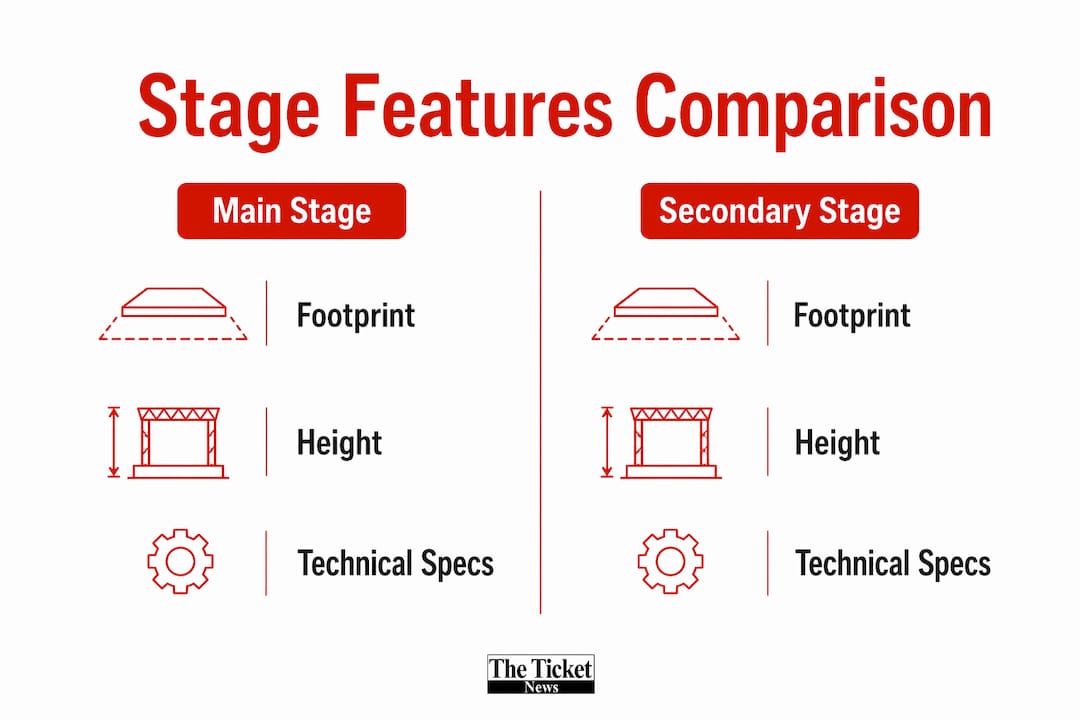
| Feature | Main Stage | Secondary Stage |
|---|---|---|
| Typical footprint | 24×40 to 24×48 ft | 16×24 to 16×32 ft |
| Stage height | 36–48 inches | 24–36 inches |
| Stage depth | 24+ ft | ~16 ft |
| Audio system | Dual front-of-house line arrays | Single PA system |
| Lighting | Full rig with moving heads | Basic wash and spot package |
| LED wall | Yes, integrated | Rarely included |
| Structural rating | Wind load engineered | Standard load only |
Pro Tip: Start structural inspections and permit applications at least six months before your festival date. Cities like Orlando require large outdoor event permits well in advance, and engineering sign-offs for main stage wind loads can take weeks to process.
Why is the main stage so central to the festival experience?
The main stage does more than host the biggest names on the bill. It functions as the narrative vessel for the entire festival, combining architecture, technology, and performance to tell the event’s story. Tomorrowland’s 2026 mainstage reveal illustrates this directly: the design incorporates water features, thematic architecture, and immersive lighting that go far beyond basic artist visibility.
For organizers, the main stage drives nearly every other operational decision:
- Crowd management: The main stage dictates where the largest concentrations of attendees will be and when, shaping security deployment and entry flow
- Sponsor visibility: Main stage backdrops and LED walls are the highest-value real estate for brand placement and live broadcast frames
- Festival identity: The stage’s visual design communicates the event’s theme before a single note is played
- Scheduling anchor: All other stages, food vendors, and programming are timed around main stage sets to distribute crowd load
Headline acts attract peak attendance and define the festival’s brand in the market. A well-programmed main stage schedule can justify ticket prices, drive media coverage, and build the kind of loyalty that brings attendees back year after year.
How has the festival main stage evolved over time?
The concept of a dedicated main stage grew alongside the outdoor music festival movement in the United States. Early festivals in the 1960s and 1970s used basic wooden platforms with rudimentary PA systems. The stage was functional, not theatrical.
That changed as production technology advanced and festival culture matured. Stages evolved from simple platforms) to structurally complex, artistic entities, with modern main stages embodying a festival’s story and identity through immersive design. The 2025 Tomorrowland mainstage fire incident, which disrupted one of the world’s largest electronic music festivals, underscored how critical contingency planning has become for large-scale structures.
Common terminology that has developed alongside this evolution:
- Main stage / mainstage: The largest performance area, used interchangeably in both theater and festival contexts
- Secondary stage / side stage: A supporting performance area with reduced production capacity
- Jam stage: An informal or spontaneous performance space, often with minimal infrastructure
- Front of house (FOH): The audio mixing position facing the stage, typically located at the center of the audience area
- Monitor engineer: The technician managing stage monitors so performers can hear themselves
- Line array: A speaker system configured in a vertical column to distribute sound evenly across large crowds
How do you plan and budget for a festival main stage?
Building a main stage is one of the largest line items in any festival budget, and the timeline is longer than most first-time organizers expect. The full build process can take up to a year of engineering coordination, vendor contracting, and safety inspections before the first act ever steps on stage.
The construction sequence matters as much as the timeline. Site preparation comes first, followed by structural rigging and scaffolding, then flooring and decking, then roofing, and finally audio, lighting, and video installations. Compressing any phase creates downstream delays and safety risks.
Budget categories to plan for from the start:
- Structural engineering and permits: Including wind load calculations and local government approvals
- Stage rental or fabrication: Main stage structures are typically rented from specialized vendors or custom-built for flagship events
- Audio system: Line arrays, subwoofers, FOH console, monitor system, and cabling
- Lighting: Moving heads, wash fixtures, control consoles, and power distribution
- LED wall: Panel rental, processing hardware, and content management systems
- Outdoor event signage: Branded signage and wayfinding for the main stage area are often underbudgeted but critical for sponsor fulfillment and crowd navigation
- Power infrastructure: Generator rental, distro panels, and fuel costs for multi-day events
How are artist lineups and schedules built around the main stage?
The main stage schedule is the backbone of the entire festival program. Headliners, typically the artists with the highest booking fees and broadest name recognition, close each night’s main stage programming. Direct support acts perform in the 60–90 minute slot before the headliner, and the schedule builds from early afternoon through the evening close.
Booking strategy for the main stage usually follows a tiered approach. The top-billed headliner anchors the final night. A second-tier headliner closes the first or second night. Supporting acts fill the afternoon and early evening slots, giving the crowd time to build. Affordable festival passes often reflect this structure, with single-day tickets priced higher for headliner nights.
Set times on the main stage are typically longer than on secondary stages, with headliners performing extended sets compared to supporting acts. Load-in and changeover windows between sets require precise stage management to keep the schedule on track.
What should you expect as an audience member at the main stage?
The main stage experience is designed around scale. Sightlines, sound coverage, and crowd flow are all engineered to serve thousands of people at once. Festival staging success depends on proportional stage sizing relative to attendance, not on overwhelming production scale, which means a well-run main stage at a 2,000-person festival can deliver a better experience than an oversized rig at an underpopulated event.
Crowd management at the main stage typically includes designated viewing sections, barrier systems near the stage front, and clearly marked entry and exit corridors. Larger festivals use wristband-gated GA (general admission) fields and tiered viewing platforms to manage density. Sound coverage is mapped in advance to minimize bleed between stages, with buffer zones between performance areas helping maintain audio clarity across the site.
Key Takeaways
The festival main stage is the largest, most technically complex performance area at any music festival, and every other element of the event is planned around it.
| Point | Details |
|---|---|
| Core definition | The main stage is the largest performance area, hosting headliners and serving as the festival’s central gathering point. |
| Size benchmarks | For 1,500–3,000 attendees, a main stage footprint of 24×40 to 24×48 ft is standard; secondary stages run 16×24 to 16×32 ft. |
| Build timeline | Planning and construction can take up to a year, covering engineering, permits, and phased installation. |
| Stage height | Main stage height typically ranges from 36 to 48 inches to maintain sightlines for large crowds. |
| Scheduling role | Headliners close each night on the main stage, with the full program built outward from those anchor slots. |
FAQ
What is a festival main stage?
A festival main stage is the largest, most technically equipped performance area at a music festival, reserved for headline acts and designed to serve as the event’s central entertainment focal point.
What does “main stage” mean at a music festival?
“Main stage” refers to the performance space with the highest audience capacity and the most advanced production setup, including full lighting rigs, LED walls, and professional line array audio systems.
What’s the difference between a main stage and a jam stage?
A main stage hosts headliners with full production infrastructure, while a jam stage is a smaller, informal performance area with minimal equipment, typically used for spontaneous or small-scale sets.
What is a festival stage in general terms?
A festival stage is any designated performance area at a music festival, ranging from the large, heavily produced main stage to smaller secondary and jam stages that support the broader programming schedule.
How long does it take to build a festival main stage?
Building a festival main stage can take up to a year of planning, engineering coordination, and phased construction, covering everything from site preparation and structural rigging to audio, lighting, and video installation.