Artists add new tour dates for one core reason: demand outpaces supply. When tickets sell out faster than expected, when streaming numbers spike, or when a market proves bigger than projected, adding shows is the most direct way to capture that revenue and serve fans who got shut out. But the decision is rarely that simple.
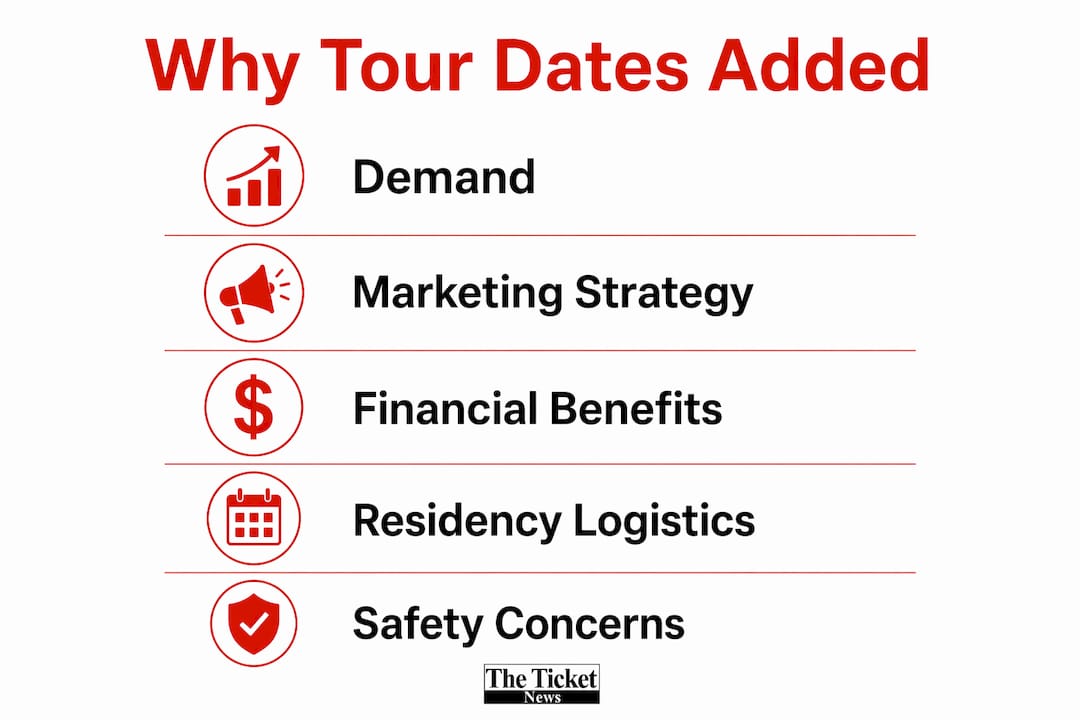
Here is what actually drives tour expansions:
- Fan demand and sellouts push artists to add shows when initial tickets vanish within minutes
- Revenue maximization through cross-collateralized deals lets strong markets offset weaker ones
- Marketing strategy uses controlled scarcity to build buzz before releasing additional dates
- Logistical efficiency makes multi-night residencies cheaper per show than moving a production city to city
Why artists add new tour dates: demand is the starting point
Sold-out shows are the clearest signal that more dates are coming. When Garth Brooks announced his Blame It All on My Roots arena tour in 2026, he initially revealed only two nights in Indianapolis. The Ticketmaster queue hit nearly 400,000 people, and Brooks added a third and fourth night within hours.
Streaming data feeds this process well before tickets go on sale. Research shows that a 20% increase in streaming can translate to an incremental $46,000–$49,000 in per-show revenue for a top-100 touring artist. Promoters and agents track these numbers closely when deciding how many dates a market can absorb.
Secondary market pricing tells the same story. When resale prices on a show spike well above face value, it signals unmet demand that a new date can address directly.
- Rapid sellouts on initial on-sale dates
- High resale prices indicating fans who missed out
- Large Ticketmaster queue sizes at on-sale time
- Streaming growth in specific markets ahead of tour announcements
How marketing strategy shapes the decision to add shows
Not every tour expansion is purely reactive. Artists and promoters sometimes announce fewer shows than they know a market can support, letting those dates sell out quickly to generate social media buzz and a sense of urgency. Booking agent Zachary Cepin described doing exactly this for singer-songwriter Jonathan Richman: he booked eight shows at a Brooklyn venue, announced four, then waited for each to sell out before revealing the next.

This is the underplay strategy. Venues like Brooklyn Steel have even installed retractable stages to lower their listed capacity, making a sellout easier to achieve and announce. The result is a narrative of perpetual demand that can translate into festival bookings, press coverage, and stronger ticket sales in the next market.
Multi-night residencies take this logic further. Karol G launched her Viajando por el Mundo Tropi Tour in 2026 with 39 concerts across 20 countries, then expanded to 64 shows after strong early ticket sales. Each new announcement became its own news cycle.
- Staged announcements create multiple waves of fan excitement
- Sold-out narratives drive press coverage and social proof
- Residency expansions generate repeat media attention
- Scarcity signals push casual fans to buy before missing out again
Pro Tip: If an artist announces a surprisingly small number of shows for a major market, watch for a sellout announcement within days. A second date is often already planned.
The financial case for adding residency nights
The economics of multi-night residencies are straightforward. A stadium production travels in dozens of trucks and takes days to rig. Play it ten times in the same building and you spread setup, trucking, and crew costs across ten nights instead of ten cities. Coldplay played ten nights at Wembley Stadium in 2025, grossing $131.4 million, the largest single-venue engagement ever for a headline artist.
Cross-collateralized deals add another layer of financial logic. When all tour dates are pooled into one settlement, revenue from strong markets offsets losses on weaker ones. Adding a date in a proven market improves the overall tour settlement, which protects both the artist and the promoter.
Destination residencies also reduce travel fatigue for artists and crew while turning each city into a fan travel hub. Harry Styles’ 2026 Together, Together tour announced 30 nights in New York City and 12 in London, drawing fans who flew in from abroad specifically for those runs.
How production and safety concerns affect scheduling
Production realities shape tour calendars in ways fans rarely see. When a stage is already loaded into a venue, promoters often hold “dark days” between shows, nights when the room sits idle but the production stays in place. Those gaps exist partly to rest the crew and partly to allow a new show to be added without the cost of tearing down and rebuilding the set.
Safety requirements can also trigger rescheduling that results in new dates. Ariana Grande rescheduled tour dates on her Eternal Sunshine tour to safely deliver the full production she had planned. Rescheduled shows often land in the same market on a new date, which effectively adds a date to the calendar even when the intent was simply to move one.
- Dark days between residency shows allow quick addition of new dates
- Safety-driven postponements create rescheduled dates in the same market
- Load-in and load-out time requirements build natural gaps into tour routing
Signs that new tour dates are coming
Knowing what to watch for can give you a real head start on tickets. Concert tickets sell out fast for predictable reasons, and those same signals often precede a date expansion.
- Quick sellouts on the initial on-sale, especially within the first hour
- Unusually small venues for an artist whose streaming numbers suggest a larger draw
- Large queue sizes at on-sale time, as seen with Garth Brooks in Indianapolis
- Low initial show count relative to an artist’s known popularity in that market
- Social media hints from the artist or their team about “more to come”
- Presale demand signals that exceed projections, as happened when Coldplay added four Wembley nights after a fan presale revealed stronger-than-expected demand
Key Takeaways
Artists add new tour dates primarily when fan demand exceeds initial supply, and the decision is reinforced by financial incentives, marketing strategy, and production logistics.
| Point | Details |
|---|---|
| Demand drives expansions | Rapid sellouts and large queue sizes are the clearest triggers for added shows. |
| Streaming predicts revenue | A 20% streaming increase can add $46,000–$49,000 per show for top touring artists. |
| Scarcity is often deliberate | Artists announce fewer dates than a market supports to manufacture buzz before adding more. |
| Residencies cut costs | Amortizing production across multiple nights in one venue improves margins on every show. |
| Dark days enable flexibility | Pre-planned off-days keep the production in place, making it fast and cheap to add a date. |
The Ticket News take on reading the tour expansion market
The conventional wisdom is that added tour dates are good news for fans. More supply means more chances to get a ticket at face value. That is true, but it misses something.
When an artist adds dates because demand genuinely overwhelmed supply, the new shows tend to sell well and the fan experience holds up. When dates are added as a pure marketing move, the calculus shifts. The first announcement was designed to sell out. The second announcement was designed to make you feel like you almost missed out again. Both can be real, and both can be manufactured.
The practical read for fans: treat a quick sellout as a signal to watch the artist’s social channels closely over the next 48–72 hours. Most added dates are announced within that window. Setting up alerts for the artist on ticketing platforms and following their official accounts gives you the best shot at face-value tickets before the secondary market absorbs the new inventory.
FAQ
Why do artists add new tour dates after selling out?
Sold-out shows signal unmet demand in a market. Artists and promoters add dates to capture that revenue and serve fans who missed out on the initial on-sale.
How far in advance do artists usually announce tours?
Most major tours are announced three to six months before the first show, though added dates can come within days of a sellout, as Garth Brooks demonstrated in Indianapolis in 2026.
How much does an artist make from a concert ticket?
Artist compensation typically works as a guarantee versus a percentage of net revenue, with splits varying widely depending on deal structure and venue scale.
Why are some artists canceling or limiting tours?
Rising production costs have made touring more expensive, pushing some artists toward fewer cities with multi-night residencies rather than broad tours, while others cancel due to health or safety concerns.