Concert tour routing is the strategic sequencing of tour dates and cities designed to minimize travel costs, reduce dead days, and create a workable schedule that sustains both performance quality and crew wellbeing. The industry term for this practice is “tour routing,” and it sits at the intersection of booking strategy, logistics, and human factors management. Whether you are managing a regional indie act or a stadium headliner, understanding how concert tour routing works determines whether a tour turns a profit or burns out the team before the final show. Orphiq, Eventric, and the FMCSA each provide frameworks that shape how professionals approach this process.
How concert tour routing works: the professional planning process
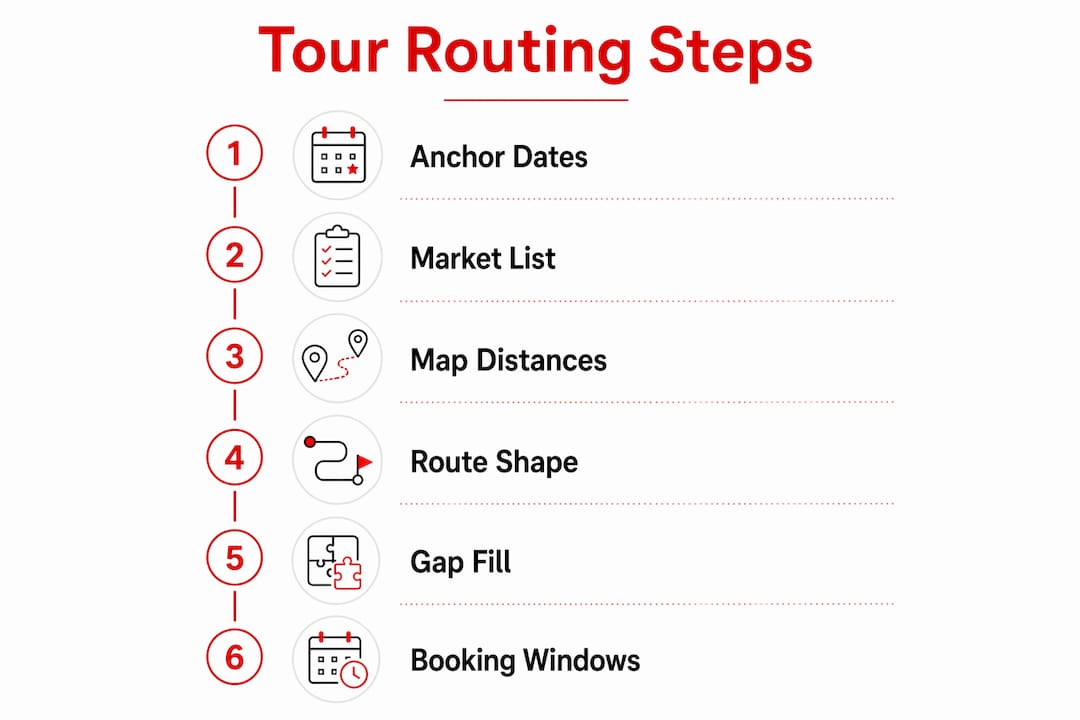
The concert routing process follows a defined sequence that professionals repeat for every tour, regardless of scale. Skipping steps or reversing the order creates scheduling conflicts that compound as the tour approaches.
Step 1: Lock anchor dates first. Anchor dates are confirmed festivals, major venue bookings, or label-mandated appearances that cannot move. Every other date builds around them. A summer festival slot in Chicago, for example, becomes the geographic and temporal center of a Midwest run.

Step 2: Build a market list. Prioritize cities based on fanbase density, venue availability, and realistic driving distance from each anchor. A market list for a 20-date tour might include 35 candidate cities, knowing that not all will confirm.
Step 3: Map distances and drive times. Tour routing sequences tour dates to minimize travel costs, with loop or line routes preferred because they reduce backtracking and eliminate expensive dead days. Google Maps works for independent artists calculating drive times between candidate cities. Larger operations use dedicated routing software that factors in rest stops, border crossings, and vehicle type.
Step 4: Sequence for route shape. Three primary route shapes exist in professional touring. A loop starts and ends in the same city, ideal for regional runs. A line moves directionally across the country, suited to cross-country tours. A hub-and-spoke model uses one city as a base for day trips or short regional clusters, common for residencies or festival-heavy schedules.
Step 5: Gap-fill with additional shows. Long travel stretches between anchor dates create dead days that cost money without generating revenue. Adding a smaller market show between two major cities breaks up the drive, generates income, and keeps the crew on a consistent schedule.
Step 6: Confirm booking windows. Venue booking windows vary significantly. Theater-level venues often book 6 to 12 months out. Club-level rooms may confirm within 6 to 8 weeks. Using spreadsheets with drive times and routing tools suffices for many independent artists, while complex tours use dedicated software to manage the volume of variables.
Pro Tip: Build your market list with 150% of the dates you actually need. Confirmations fall through, venues go dark, and promoters pass. Having excess candidates means you fill gaps without scrambling.
What logistical and regulatory constraints shape routing decisions?
Concert tour logistics extend well beyond city sequencing. Regulatory and operational constraints set hard limits on what is physically achievable between shows.
The most underestimated constraint is the FMCSA Hours-of-Service framework. FMCSA Hours-of-Service limits for property-carrying drivers include an 11-hour driving maximum and a 14-hour on-duty window that covers all non-driving tasks as well. Loading, fueling, paperwork, and waiting at venue docks all consume that on-duty clock. A 9-hour drive that looks feasible on paper becomes impossible once you account for a 90-minute load-out, a fuel stop, and a 45-minute delay at the next venue’s dock.
Show day timing creates a second layer of constraint. A typical show day runs from load-in through curfew, and every element must fit inside the available travel window. Routing must include day-to-day show timing like load-in, soundcheck, and curfew to determine achievable travel windows. A 10 PM curfew in one city followed by a noon load-in the next day leaves roughly 10 hours for travel, load-out, transit, and rest. That window shrinks fast.
Key operational constraints that routing must account for include:
- Venue dock access hours: Many venues restrict truck access to specific windows, often 8 AM to 5 PM, which forces arrival timing regardless of drive distance.
- Security and credentialing protocols: Larger venues require advance credentialing that takes time on arrival, reducing the effective setup window.
- Soundcheck duration: A full production soundcheck for a mid-level act runs 60 to 90 minutes minimum. Routing that leaves no buffer before doors open creates quality problems.
- Mandatory rest periods: FMCSA regulations require a 10-hour off-duty rest period before a driver can begin a new on-duty window. This is non-negotiable and must be built into the schedule.
Pro Tip: When evaluating a potential routing move, calculate drive time plus load-out time plus mandatory rest, not just miles. A 400-mile drive that looks manageable often isn’t once you add 2 hours of load-out and a 10-hour rest requirement.
Advance work connects directly to routing reliability. Submitting a stage plot and input list at least one week ahead shortens soundcheck and improves routing reliability. When production teams arrive at a venue that already has the technical rider, the stage plot, and the input list, setup moves faster and the schedule holds.
How does routing affect performance quality and crew wellbeing?
Routing is not just placing cities on a map. It is about creating day-to-day workable conditions that account for travel, load-ins, early mornings, and recovery time. This distinction separates tours that finish strong from tours that fall apart in week three.
Long drives affect load-in times, soundcheck quality, and crew alertness more than raw mileage suggests. A 6-hour overnight drive arriving at 6 AM means a crew that has been awake for 20 hours is setting up a stage by 8 AM. The show that night will reflect that. Routing that prioritizes reset time over shortest distance produces measurably better performances.
“Good routing is constraint-driven planning that balances minimizing dead days with protecting performance quality and crew rest.” — Orphiq
Fatigue management is a scheduling discipline, not a soft concern. One day off per 4 to 5 show days is the standard recommendation for maintaining performance quality on extended runs. That rest day is not wasted revenue. It is an investment in the remaining shows on the tour. An artist who performs 20 strong shows generates more long-term career value than one who grinds through 25 shows with declining quality.
Routing decisions are iterative and must flexibly adapt to new shows, cancellations, and unforeseen issues to maintain manageability. A venue that drops out three weeks before the tour forces a re-evaluation of the surrounding dates. Routes that are designed with flexibility built in, meaning buffer days and alternative market options already identified, absorb these disruptions without cascading into larger scheduling failures.
What tools and documentation support daily tour logistics?
Effective tour routing strategies require documentation systems that translate the route into actionable daily schedules. The tools range from simple spreadsheets to purpose-built tour management platforms.
The tour-day worksheet is the operational backbone of any show day. A tour-day worksheet combines all routing-linked schedule details: arrival time, load-in, soundcheck, set time, curfew, parking instructions, and unloading logistics. This document centralizes communication and reduces confusion for artists, crews, and venues operating from a shared schedule.
| Document | Purpose | Key contents |
|---|---|---|
| Tour-day worksheet | Daily operations guide | Arrival, load-in, soundcheck, set, curfew, parking |
| Advance sheet | Production contract | Technical rider, stage plot, input list, venue contacts |
| Routing spreadsheet | Travel planning | Drive times, distances, hotel locations, fuel stops |
| Market list | Booking reference | Candidate cities, venue names, capacity, promoter contacts |
The advance sheet functions as the operational contract between the routing plan and the production team. The advance sheet creates a standardized timing document used by production and venue teams operating from a shared schedule on show day. When the advance sheet is complete and distributed before the tour begins, show days run on schedule because everyone has the same information.
For independent artists building their first routing spreadsheet, the minimum viable document includes venue name, city, confirmed date, drive time from the previous city, load-in time, and promoter contact. Adding hotel location and nearest fuel stop turns that spreadsheet into a functional daily operations tool. Resources like event timeline planning guides provide scheduling templates that adapt well to tour-day worksheet formats.
Routing must coordinate with venue advance work to avoid cascading delays that hurt show revenue and reputation. Real-time routing updates, shared via cloud-based spreadsheets or tour management platforms, keep the entire team aligned when changes occur mid-tour.
Key takeaways
Concert tour routing works because it integrates travel constraints, regulatory limits, production timing, and human fatigue into a single sequenced plan that determines whether a tour succeeds financially and operationally.
| Point | Details |
|---|---|
| Start with anchor dates | Build every routing decision around confirmed, immovable shows before adding other markets. |
| Route shape matters | Loop, line, and hub-and-spoke shapes each reduce backtracking and dead days differently depending on tour geography. |
| FMCSA rules set hard limits | Driver on-duty windows include loading and waiting time, not just driving, which restricts feasible daily travel. |
| Rest days protect revenue | One day off per 4 to 5 show days maintains performance quality and reduces costly errors from crew fatigue. |
| Documentation drives execution | Tour-day worksheets and advance sheets translate the routing plan into shared, actionable schedules for every team member. |
The routing reality most people miss
The Ticket News has tracked hundreds of tours across genres and scales, and the most consistent mistake we see is treating routing as a geography problem rather than a human performance problem. Booking agents sequence cities on a map and declare the routing done. Tour managers then spend the first two weeks of the tour firefighting problems that were baked into the schedule before anyone left home.
The tours that run smoothly share one characteristic: the routing was built backward from show day requirements, not forward from a map. Someone asked, “What does the crew need to arrive, set up, and perform well?” before they asked, “What is the shortest path between these cities?”
Flexibility is the other undervalued asset. We have seen tours where a single venue cancellation three weeks out triggered a complete re-routing of a 15-date run because there was no contingency built in. The tours that absorb disruptions without drama are the ones where the routing team identified backup markets during the planning phase and kept those relationships warm.
Our honest recommendation: spend twice as long on the advance work as you think you need to, and build one extra rest day into every week of touring. The shows you protect with that rest day will outperform the show you would have added in its place.
— The Ticket News
Plan your next concert experience with The Ticket News
Understanding how concert tour routing works gives you a sharper eye for the shows worth attending and the tours worth following from city to city.

The Ticket News tracks tour announcements, venue schedules, and last-minute concert tickets across genres so you never miss a show when a tour hits your market. Whether you are a music professional researching how tours are structured or a fan looking for ways to save on concert tickets, The Ticket News connects you to the events and deals that matter. Visit theticketnews.com for current tour dates, ticket options, and music industry coverage updated daily.
FAQ
How does concert tour routing work at a basic level?
Concert tour routing is the process of sequencing show dates and cities to minimize travel time, reduce dead days, and create a schedule that is financially and operationally sustainable. Professionals start with anchor dates and build outward using drive time calculations and venue availability.
What is the difference between a loop route and a line route?
A loop route starts and ends in the same city, reducing repositioning costs at the end of the tour. A line route moves directionally across a region or country, suited to cross-country tours where returning to the origin city is not practical.
How do FMCSA Hours-of-Service rules affect tour routing?
FMCSA rules limit property-carrying drivers to 11 hours of driving within a 14-hour on-duty window, and that window includes loading, fueling, and waiting time. Routing that ignores these limits creates illegal schedules and puts drivers and crews at risk.
Why do tours include rest days in the routing plan?
One rest day per 4 to 5 show days is the standard for maintaining performance quality and managing crew fatigue. Rest days reduce errors during load-in and soundcheck and protect the quality of the remaining shows on the tour.
What is an advance sheet in concert tour logistics?
An advance sheet is the standardized document shared between the touring production team and the venue before show day, containing technical requirements, timing, and contacts. It acts as the operational contract that aligns routing decisions with production execution.