A North American tour leg is a defined segment of a concert tour where shows are grouped specifically within North America for logistical and scheduling efficiency. The term “tour leg” is the standard industry phrase used by promoters, managers, and press releases to describe a distinct operational phase of a larger tour. Understanding what a North American tour leg means helps you decode tour announcements, predict ticket release windows, and plan your concert attendance with far more confidence than most fans manage.
What is a North American tour leg, exactly?
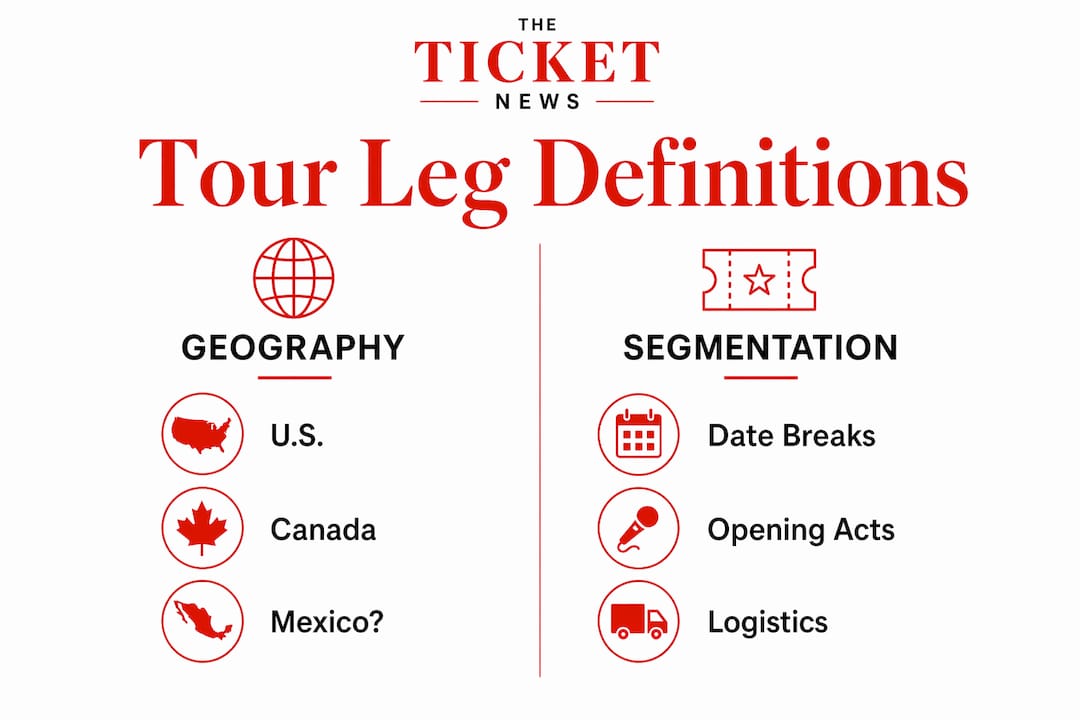
A concert tour leg is a segment of a tour distinguished by geography, date breaks, or changes in opening acts. The North American leg specifically groups performances across the United States, Canada, and sometimes Mexico into one continuous or near-continuous block of shows. When a band like Metallica or Radiohead announces a world tour, the North American portion gets treated as its own operational unit because the geography, crew logistics, and scheduling demands are fundamentally different from a European or Asian leg.
The word “leg” comes directly from touring industry practice. It describes one stretch of a journey before a significant stop or change. Think of it like a road trip broken into segments. You drive from New York to Chicago, rest, then continue to Los Angeles. Each stretch is a leg. For a major touring act, the North American leg is one of those stretches, and it carries its own production plan, crew roster, and schedule.

What makes this concept worth understanding is that legs are practical divisions based on logistics, not just marketing. A press release announcing a North American leg implies a distinct operational phase with specific local crews and logistics, separate from other continents. When you see that announcement, you are looking at a self-contained touring machine built specifically for North American venues and audiences.
How are tour legs defined and segmented?
Several factors determine where one leg ends and another begins. These are not arbitrary marketing decisions. They reflect real operational boundaries that touring teams use to manage productions at scale.
The primary factors that define a tour leg include:
- Geography: The most common dividing line. North America, Europe, Asia, and Australia each represent natural geographic groupings that simplify routing and crew management.
- Date blocks: A gap of two weeks or more between shows often signals a new leg. The break allows for production resets, crew rest, and advance team preparation in the next region.
- Opening act changes: When the supporting artist changes, it frequently marks a new leg. Opening acts often have their own regional contracts and availability windows.
- Production crew rotations: Large tours may employ separate localized crews per leg, meaning the team loading in at Madison Square Garden may be entirely different from the crew working a European arena two months later.
The geographic grouping for North America typically includes the U.S. and Canada as the core, with Mexico sometimes added depending on the artist’s market presence and routing efficiency. Border crossings between the U.S. and Canada or Mexico add logistical complexity, including customs paperwork for equipment and work permits for crew members. These realities make North America a natural unit that touring teams plan around as one cohesive block.
How does the North American leg shape tour logistics?
The logistical weight of a North American leg is significant. Routing a tour across dozens of cities while keeping the production on schedule, the crew rested, and the artist performing at full capacity requires detailed planning that most fans never see.
Here is how the process typically works for a major North American leg:
- Routing is mapped first. Tour managers plot city sequences that minimize unnecessary travel. A tour jumping from Los Angeles to New York and back to Chicago wastes time and money. Efficient routing moves in geographic arcs, such as a West Coast run followed by a Midwest sweep and then an East Coast stretch.
- Travel time and rest days are built in. Routing must consider travel time, load-in timing, recovery time, border crossings, and local venue workflows to create workable legs. A show in Toronto followed immediately by a show in Dallas is physically possible but operationally brutal.
- Advance teams move ahead of the main production. While the artist performs in one city, an advance crew is already in the next city confirming venue logistics, local labor contracts, and equipment delivery windows.
- Management structure scales with tour size. Small tours use road managers while large tours require full tour managers overseeing multiple departments. A stadium tour’s North American leg might involve a tour manager, production manager, stage manager, and separate department heads for lighting, sound, and merchandise.
- Border logistics are planned well in advance. Moving production equipment from the U.S. into Canada requires customs documentation called a carnet, which lists every piece of gear. Missing paperwork can delay an entire production.
Pro Tip: If you are trying to predict when tickets for a second North American leg will go on sale, watch for the artist’s social media activity around the midpoint of the first leg. Announcements for additional dates typically drop while the current leg is generating buzz and demand.
Tour routing decisions balance movement, rest, and operational constraints beyond just geography. This is why a North American leg sometimes skips obvious markets. A city might be geographically convenient but logistically difficult due to venue availability, local permit timelines, or simply the need to give the crew a travel day.
Why do some tours have multiple North American legs?
Many major tours split the North American portion into two or more separate legs. This is more common than most fans realize, and it has concrete reasons behind it.
The table below compares the typical characteristics of a first versus second North American leg on the same tour:
| Feature | First North American leg | Second North American leg |
|---|---|---|
| Timing | Spring or early summer | Late summer or fall |
| Venues | Mix of arenas and amphitheaters | Often larger venues or added markets |
| Opening acts | Original announced support | New or different supporting artists |
| Production | Initial setup, sometimes still evolving | Refined, often with updated staging |
| Ticket availability | Announced well in advance | Sometimes added due to demand |
Multiple North American legs may differ in venues, opening acts, and production setups to suit seasonal markets or artist stamina. An artist who sells out arenas in the spring might upgrade to stadiums for a fall return leg. Alternatively, a second leg might fill in markets the first leg skipped due to routing constraints.
Seasonal factors play a real role. Outdoor amphitheater shows work best in summer. Indoor arena tours can run year-round. A band planning a summer amphitheater run followed by a fall arena leg is essentially running two distinct North American legs with different production requirements and audience experiences. Leg boundaries often reflect production load-in schedules and team rotations, marking logical restarts in intense touring periods.
For fans, multiple legs mean multiple chances to see a tour. If you missed tickets for the first leg, a second leg announcement is your opportunity. Artists like Ed Sheeran and Kanye West have both used multiple North American runs to maximize audience reach across different seasons and markets.
What concert-goers should know about following a North American leg
Understanding how tour legs work gives you a practical edge when planning your concert experience. Here is what matters most for fans:
- Duration varies widely. North American legs typically last several weeks to months depending on the tour. A club tour might run three weeks. A stadium tour’s North American leg could span four months.
- City selection follows routing logic. Not every major city gets a show on every leg. If your city is skipped, a second leg or a nearby market may be your best option.
- Merchandise varies by leg. Tour merchandise is often designed per leg, with leg-specific items available only at shows within that segment. Collectors know to buy at the first show they attend rather than waiting.
- Ticket release patterns follow leg announcements. When a North American leg is announced, tickets for all shows in that leg typically go on sale within the same window, often on the same day. Understanding this helps you prepare rather than scramble.
- Opening act announcements come later. The headliner is announced first. Supporting acts for a North American leg are often confirmed weeks or months after the initial tour announcement.
Pro Tip: Sign up for artist newsletters and follow their official social accounts before a tour announcement drops. Pre-sale codes for North American leg tickets are almost always distributed through these channels 24 to 48 hours before the general public sale.
Understanding legs clarifies tour announcements and helps fans track ticket releases and tour momentum more effectively. When you see “https://expedia.stay22.com/capitalcitytickets/C33BaDK9Rt
” in a press release, you now know you are looking at a self-contained touring phase with its own schedule, crew, and production plan.
Key takeaways
A North American tour leg is a self-contained operational phase of a concert tour, defined by geography, date blocks, and production logistics that are specific to the U.S., Canada, and sometimes Mexico.
| Point | Details |
|---|---|
| Tour leg definition | A leg is a distinct tour segment separated by geography, date breaks, or opening act changes. |
| North American scope | The North American leg covers the U.S. and Canada as a core unit, sometimes including Mexico. |
| Logistics drive structure | Routing, crew rotations, and border crossings shape how and why legs are divided as they are. |
| Multiple legs are common | Artists split North America into two or more legs for seasonal, logistical, or demand-based reasons. |
| Fan planning advantage | Knowing how legs work helps you anticipate ticket sales, merchandise availability, and added dates. |
The Ticket News take on why legs matter more than fans think
Most fans treat a tour announcement as a single event. They check if their city is on the list, buy a ticket, and move on. But the leg structure of a tour tells you far more than just the dates.
When a major artist announces a North American leg, they are signaling a production commitment of serious scale. The Metallica WorldWired Tour is a good example of how a North American leg can define an entire touring era for a band. The leg structure determined which markets got stadium shows versus arena shows, and fans who understood the leg logic knew which cities were likely to get added dates when the first leg sold out quickly.
The misconception we see most often is fans assuming that a “North American tour” is one continuous run. It rarely is. There are breaks, resets, and sometimes entirely separate legs announced months apart. When fans understand that a second leg is a fresh operational phase and not just extra dates, they stop panicking about missing the “only chance” to see a show.
There is also something genuinely exciting about the leg structure from a fan experience perspective. A second North American leg often features a more polished production, sometimes a different setlist, and occasionally a completely different supporting act. Seeing the same tour on two different legs can feel like two different shows. That is not a bug in the touring system. It is a feature that rewards fans who pay attention.
— The Ticket News
Plan your next show with The Ticket News

The Ticket News tracks North American tour schedules, leg announcements, and ticket sale dates so you never miss a window. Whether you are following a stadium headliner’s multi-leg run or hunting for affordable tickets to a regional amphitheater show, The Ticket News provides the tour details and purchasing options you need. From Radiohead North American dates to emerging artists making their first North American run, the site covers the full spectrum of live music. Visit The Ticket News to browse current tour announcements, compare ticket prices, and get ahead of the next on-sale date before the general public even knows it is coming.
FAQ
What is a tour leg in music?
A tour leg is a distinct segment of a concert tour, separated from other segments by geography, a break in dates, or changes in the supporting lineup. It functions as a self-contained operational phase with its own routing, crew, and production plan.
Does the North American leg include Canada and Mexico?
The North American leg typically covers the United States and Canada as its core geographic unit. Mexico is sometimes included depending on the artist’s market presence and routing logistics, but it is not always part of every North American leg.
Why do artists split North America into multiple legs?
Artists split North America into multiple legs for seasonal scheduling, venue upgrades, production resets, or to meet demand in markets skipped during the first leg. A second leg often features different venues, updated staging, or new supporting acts.
How long does a North American tour leg usually last?
North American legs typically run several weeks to several months depending on the scale of the tour. A club or theater tour might span three to four weeks, while a stadium or arena tour’s North American leg can run three to five months.
How do tour legs affect ticket sales for fans?
When a North American leg is announced, tickets for all shows in that segment typically go on sale within the same window, often on the same day. Pre-sale codes are usually distributed through artist newsletters and official social channels 24 to 48 hours before the public sale opens.
Leave a Reply