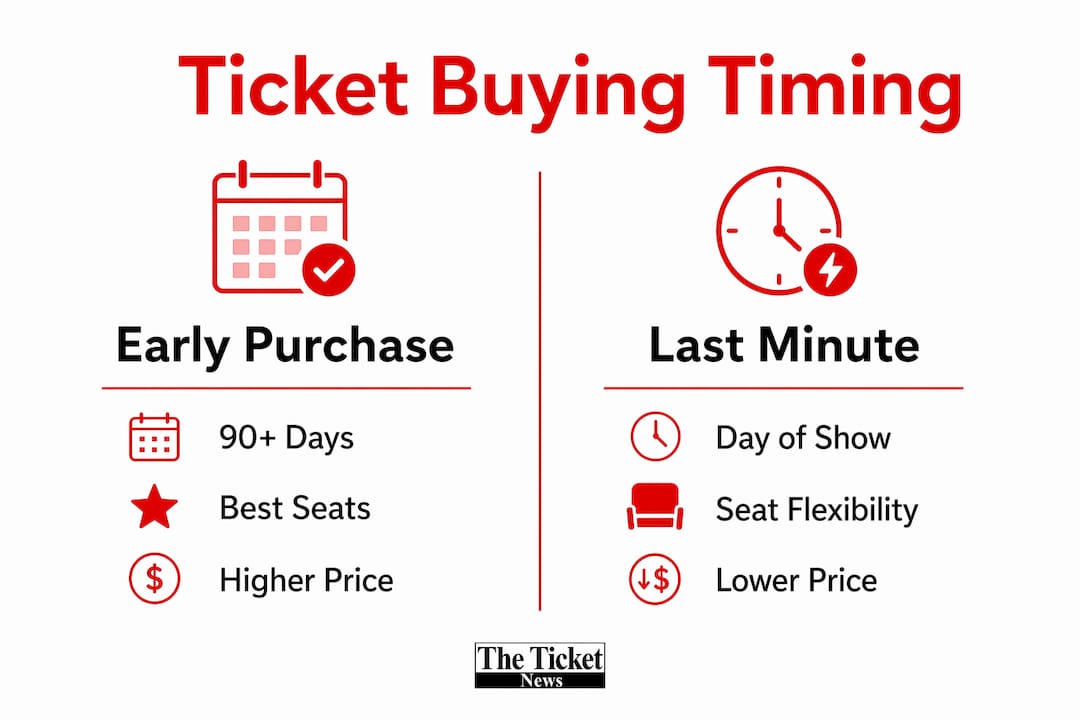
The best time to buy concert tickets is either 90 or more days before the event or on the day of the show itself. These two windows consistently deliver the lowest prices across the resale market. Early buyers pay a median of $139, while day-of buyers pay just $99. The worst window is 2–4 weeks out, when the median price peaks at $162. Dynamic pricing, sellout risk, and inventory levels all shape which window works best for you. Understanding these forces is the difference between a great deal and an overpriced seat.
How do concert ticket prices change over time?
Concert ticket pricing follows a predictable curve across the sales lifecycle. Prices start moderate at launch, climb steadily as the event approaches, peak sharply in the 2–4 week window, then fall on the day of the show when sellers need to move inventory fast.
The numbers tell a clear story. Prices 90+ days out average $139, which is 14% cheaper than the peak window. That peak window, 2–4 weeks before the event, carries a median price of $162. Then, on the day of the show, prices drop to a $99 median. That is a 29% discount compared to the peak.

Two forces drive this curve: urgency and inventory. As the event date closes in, buyers feel pressure to commit, and sellers know it. Inventory shrinks, competition rises, and prices climb. On the day of the show, the dynamic flips. Sellers holding unsold tickets face a hard deadline. They drop prices to avoid a total loss.
High-demand events vs. replaceable ones
Not every concert follows the same curve. Personal finance expert Preet Banerjee’s Rule No. 1 for ticket buying is assessing sellout risk before deciding when to act. That single question changes everything.
- High-demand events (major touring artists, festival headliners, one-night-only shows): prices rise as the date approaches and seats disappear. Waiting is a gamble.
- Liquid, replaceable events (artists with multiple tour dates in the same city, mid-tier acts): supply stays healthy longer, and prices often soften near the event.
“The key question is whether the event will sell out. If it will, buy early. If it won’t, you have time to wait for a better price.” — Preet Banerjee, personal finance expert
For a Taylor Swift-level show, waiting for a day-of deal is a fantasy. For a regional act with three dates in your market, patience pays off. Knowing which category your target show falls into is the foundation of every good timing decision.
What are the cheapest days and months to buy tickets?
Timing your purchase to the right day of the week and the right month of the year produces real savings. These patterns exist because of how sellers list and reprice inventory.
Saturdays are consistently the cheapest day to buy concert tickets, running about 9% cheaper than midweek purchases. Sellers tend to reprice and list new inventory over the weekend when they have more time. That increased supply on Saturdays pushes prices down slightly but meaningfully.
Monthly patterns are even more dramatic. March is the cheapest month to buy tickets. Prices in march run 67% lower than peak months like September. September is expensive because it sits in the heart of the fall concert season, when demand is highest and inventory is tightest.
- Cheapest day: Saturday
- Most expensive days: Tuesday and Wednesday (midweek urgency pricing)
- Cheapest month: March
- Most expensive month: September
Pro Tip: Check prices on Saturday mornings. Sellers often post new listings and price drops over the weekend, giving you first access to the freshest inventory at the lowest ask.
These patterns do not override event-specific demand. A Saturday in march still will not get you cheap tickets to a sold-out arena show. But for events with healthy supply, these timing windows give you a real edge.
Early vs. last-minute: which strategy wins?
The right strategy depends on two things: how much you care about seat location, and how flexible you are about attending at all. Neither approach is universally better. They solve different problems.
Buying 90+ days in advance
Early purchase is the right move when seat selection matters to you. At 90+ days out, the full inventory is available. You can filter by section, row, and view. You pay $139 median, which is 14% below the peak price. You also eliminate the risk of the show selling out entirely.
- Set a calendar alert for the official public on-sale date.
- Have your payment method ready before the sale opens.
- Filter by your preferred section first, then sort by price within that section.
- Buy within the first hour of the on-sale window for the best seat-to-price ratio.
For major touring artists, buying at public on-sale guarantees face-value seats at the best available locations. Waiting even a few days after the on-sale can mean paying a resale premium on top of the original price.
Pro Tip: Sign up for artist fan club presales. These often open 24–48 hours before the public on-sale and give you access to reserved inventory at face value before the general rush.
Buying day-of or last minute
Last-minute buying works when you are flexible on seating and focused purely on price. Day-of tickets average $99, which is the lowest median price across the entire sales lifecycle. The trade-off is limited seat selection and the risk that the show sells out before you act.
| Factor | Early purchase (90+ days) | Last-minute (day-of) |
|---|---|---|
| Median price | $139 | $99 |
| Seat selection | Full inventory | Limited remaining |
| Sellout risk | Eliminated | High for popular shows |
| Best for | Seat-conscious buyers | Price-first, flexible buyers |
| Worst for | Budget-only buyers | Fans with specific seat needs |
For last-minute concert deals, focus on shows with multiple dates or artists who have not sold out previous stops on the same tour. Those are the events where day-of inventory is most likely to exist at a real discount.
What mistakes should you avoid when timing your purchase?
The most expensive mistake concert fans make is buying in the 2–4 week window before the show. That is when peak window prices hit $162 median, the highest point across the entire sales cycle. Urgency and shrinking inventory combine to push prices up sharply. Buyers in this window pay a premium for procrastination.
- Avoid the 2–4 week window unless you have no other option. Prices are at their highest and seat selection is already reduced.
- Do not skip the official on-sale for high-demand shows. Missing the on-sale for a major artist means paying resale markup from day one.
- Do not wait for a day-of deal on a sellout-risk show. If the event is likely to sell out, the day-of inventory may not exist at all.
- Do not assume all resale prices are fair. Use a concert ticket resale checklist to verify legitimacy and compare prices before committing.
Pro Tip: Run a quick resale check 30 days before your target show. If prices are already above face value and inventory is shrinking, buy immediately. If prices are flat or dropping, you can afford to wait.
Patience is a real advantage in the ticket market, but only when applied to the right events. Knowing why concerts sell out fast helps you recognize when patience becomes a liability.
How can you track ticket prices to find the best deals?
Tracking ticket price history and market data analytics gives you a clear view of where prices are heading before you commit. Most buyers make decisions based on a single price check. Buyers who track trends over time make better decisions.
The core indicators to watch are: current median price, inventory level (how many tickets are listed), and price direction (rising, flat, or falling). When inventory drops and prices rise together, the market is tightening. Buy immediately. When inventory is stable and prices are flat or falling, you have room to wait.
| Indicator | What it tells you | Action |
|---|---|---|
| Rising price + falling inventory | Market tightening, sellout risk increasing | Buy now |
| Flat price + stable inventory | Healthy supply, no urgency | Monitor weekly |
| Falling price + high inventory | Oversupply, seller competition | Wait for further drops |
| Day-of price drop | Sellers clearing unsold seats | Buy if flexible on seat |
Monitoring price trends across multiple weeks reveals the natural price floor for a given event. The price floor is the lowest realistic price the market will reach before the show. Buying near that floor, rather than at the first price you see, is the single most effective habit for consistent savings.
The Ticket News take on timing vs. seat preference
Timing strategy in the concert ticket market is not one-size-fits-all. After tracking pricing patterns across hundreds of events, the clearest lesson is this: most fans overpay because they conflate urgency with necessity.
The 2–4 week window feels like the natural time to buy. The show is close enough to feel real, but far enough to feel like there is still time to find a deal. That feeling is exactly wrong. That window is the market’s peak, and buyers who act there are funding sellers’ best margins.
The fans who consistently pay less do one of two things. They buy very early, before the market heats up, and they accept that they are locking in a price before they know exactly how popular the show will become. Or they wait until the day of the show, accept whatever seats remain, and treat the savings as the reward for flexibility.
The middle path, buying 2–4 weeks out, delivers the worst of both worlds: higher prices and reduced seat selection. The data is unambiguous on this point.
The one exception worth noting is the official on-sale moment for a genuinely high-demand artist. At that moment, face-value tickets are available at the lowest price they will ever reach. Missing that window for a sellout-risk show is a mistake that no amount of later timing strategy can fix.
— The Ticket News
Concert ticket deals and resources from The Ticket News
The Ticket News covers the full spectrum of concert ticket buying, from tracking price history to finding last-minute deals on major tours.

Whether you are planning months ahead or deciding the morning of the show, The Ticket News provides the market data and buying guides you need. Check the latest ticket buying tips for up-to-date pricing trends, on-sale alerts, and event-specific strategies. You can also review the full breakdown of concert ticket discount types to understand every savings option available before you buy.
Key takeaways
The best time to buy concert tickets is either 90+ days in advance or on the day of the show, with the 2–4 week window consistently delivering the highest prices and the worst value.
| Point | Details |
|---|---|
| Early buying saves on seats | Buying 90+ days out costs a $139 median and gives you full seat selection. |
| Day-of deals are real | Day-of tickets average $99, but seat choice is limited and sellout risk is high. |
| Avoid the peak window | The 2–4 week window carries a $162 median price, the highest in the sales cycle. |
| Saturdays and march are cheapest | Saturdays run 9% cheaper than midweek; march prices are 67% below September peaks. |
| Sellout risk changes everything | Assess sellout risk first. High-demand shows require early action; liquid events reward patience. |
FAQ
When is the best time to buy concert tickets?
The best time is either 90+ days before the event, when median prices are $139, or on the day of the show, when prices drop to a $99 median. The 2–4 week window before the event is the most expensive period to buy.
What day of the week are concert tickets cheapest?
Saturdays consistently offer the lowest ticket prices, running about 9% cheaper than midweek purchases. Sellers tend to reprice and list new inventory over the weekend, which increases supply and lowers prices.
Is it worth waiting for last-minute concert tickets?
Last-minute tickets are worth waiting for if you are flexible on seating and the show is not a sellout risk. For high-demand artists, waiting risks missing the event entirely or paying a higher resale premium.
What month has the cheapest concert ticket prices?
March is the cheapest month to buy concert tickets, with prices running 67% lower than peak months like September. September sits in the heart of fall concert season, when demand and prices are both at their highest.
Should I buy tickets at the official on-sale or wait for resale?
For major artists with sellout risk, buying at the official public on-sale secures face-value seats at the best available locations. Waiting for resale on high-demand shows almost always means paying a premium above face value.