Dynamic ticket pricing is a real-time pricing model where ticket costs shift based on demand, remaining inventory, and market conditions rather than staying fixed from the moment tickets go on sale. Platforms like Ticketmaster and FreshTix use algorithms that continuously read sales velocity, competitor pricing, and timing signals to push prices up or down automatically. For live music specifically, this model operates differently than in airlines or hotels because concert tickets are a genuinely scarce commodity with a hard cutoff date, which makes price swings more extreme and more personal.
Here is what defines dynamic ticket pricing in practice:
- Prices are not fixed at announcement. The price you see on day one may be very different from what you see on day ten.
- Algorithms drive the adjustments. No human is manually repricing every seat; automated systems handle thousands of updates daily.
- Both directions are possible. Prices can rise when demand spikes and fall when sales slow, making timing a real factor in what you pay.
- Demand, inventory, and timing are the primary inputs. Secondary factors include competitor event dates, day of week, and geographic demand patterns.
- It differs from static pricing, where a price floor is set at launch and stays there regardless of how the market moves.
The sections below break down exactly how the mechanics work, who benefits and how, what strategies organizers use, and what the current U.S. market data indicates about where this is all heading.
How dynamic ticket pricing actually works at concerts and live events
The engine behind real-time ticket pricing is an algorithm that reads multiple data streams at once. Pricing algorithms factor in demand fluctuations, remaining inventory, competitor pricing, and time to event, then calculate an optimal price and update it continuously during the sales window. The result is a price that can change between the moment you add a ticket to your cart and the moment you check out.

Two main approaches govern how those changes happen. Rule-based pricing sets predefined triggers: if fewer than 200 seats remain in a section, raise the price by 15%. Fully algorithmic pricing is more fluid, using machine learning to predict demand curves and adjust prices without fixed thresholds. Most major platforms blend both, using rules as guardrails and algorithms to optimize within them.
What makes live events particularly volatile is the inventory ceiling. An arena holds a fixed number of seats, and once the show sells out, no additional supply enters the market. That scarcity amplifies every demand signal. When Ticketmaster introduced dynamic pricing in 2022, Bruce Springsteen tickets reached $4,000–$5,000 and Blink-182 seats hit $600, figures that shocked fans accustomed to face-value pricing.
One wrinkle specific to live events is the digital waiting room. Fans queue online, sometimes for hours, and often do not see the final price until they are nearly at checkout. That late-stage price reveal causes transparency challenges not typically present when booking a flight, where multiple fare options are visible upfront before you commit to anything.
Operational steps in a typical dynamic pricing cycle:
- Sales open at a base price set from historical demand data and artist profile
- Algorithm monitors real-time sales velocity every few minutes
- Inventory thresholds trigger automatic price adjustments upward or downward
- Competitor event dates and local market signals feed into the model
- Price floors prevent tickets from dropping below a minimum acceptable level
- Price ceilings cap how high tickets can go, though platforms set these internally
- Final price is confirmed at checkout, not always at cart entry
Pro Tip: If you are buying tickets for a high-demand show, open the purchase page early and move through checkout quickly. Prices can update between the time you enter the queue and the time you confirm payment, so hesitation costs money on a hot sale.
Who actually benefits from dynamic pricing for events
Dynamic pricing is not a one-sided arrangement, even though it often gets framed that way. Revenue optimization and inventory management are the clearest wins for organizers, but attendees have real opportunities too, especially if they understand how the model works.
Benefits for event organizers:
- Revenue maximization. Prices rise with demand, capturing value that would otherwise flow to scalpers on the secondary market.
- Inventory control. Slow-selling sections can be repriced downward to fill seats that would otherwise go empty.
- Market segmentation. Different price tiers emerge naturally, letting fans with higher willingness to pay self-select into premium pricing while budget buyers wait for softer demand windows.
- Reduced scalping incentive. When the primary market captures peak prices, the profit margin for resellers shrinks.
Benefits for attendees:
- Lower prices during soft demand. Tickets to mid-week shows, less-hyped openers, or events in slower markets often drop below the original face value.
- Fairer allocation. When the primary market prices at market rate, fans who actually want to attend are competing on price rather than losing to bots buying at artificially low fixed prices to flip.
- Access to last-minute deals. Organizers sometimes drop prices close to the event date to fill remaining inventory, which rewards flexible buyers.
The scalping reduction point deserves a closer look. When a fixed-price ticket sells for $50 but resells for $300, the $250 gap goes to a reseller, not the artist or venue. Dynamic pricing shrinks that gap by letting the primary market capture more of that value. It does not eliminate the resale market, but it does change the math for professional scalpers. You can read more about how ticket resale markets work and why this dynamic matters for fans.
Pro Tip: For shows that are not immediate sellouts, check prices again two to three weeks before the event date. Organizers often drop prices on remaining inventory as the show approaches, and that window can be the best time to buy.
Common dynamic pricing strategies and best practices for live event management
Event organizers do not apply a single universal formula. The approach varies by artist profile, venue size, market, and how much price sensitivity the fan base has shown historically. Several distinct strategies tend to appear across the U.S. live music market.

Time-based pricing is the most straightforward. Prices start at one level when tickets go on sale, then step up at defined intervals as the event date approaches. This rewards early buyers and creates urgency without requiring real-time algorithmic monitoring.
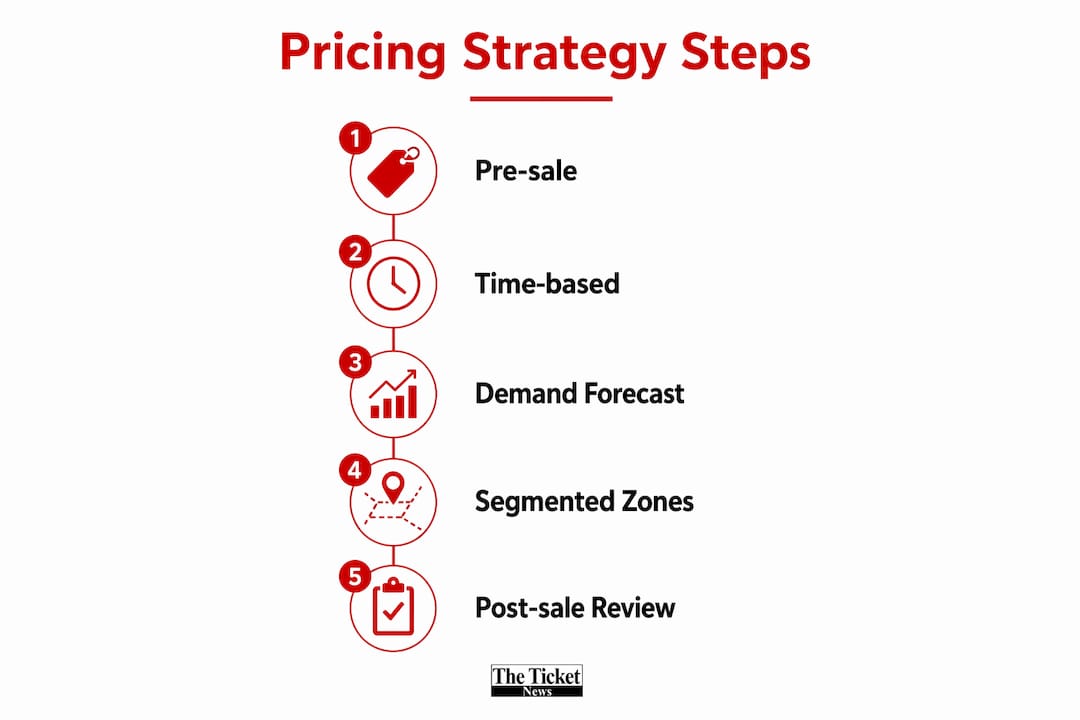
Demand forecasting uses historical sales data, streaming numbers, social media engagement, and presale performance to predict how quickly a show will sell. Organizers set initial prices and adjustment rules based on those forecasts before the sale even opens.
Segmented pricing divides the venue into zones with different pricing models. Floor seats near the stage might use aggressive dynamic pricing while upper-level seats stay closer to fixed pricing to maintain accessibility. This approach protects the fan experience in affordable sections while capturing maximum value in premium areas.
Competitor-responsive adjustments account for other events happening in the same market on the same weekend. If a rival show announces nearby, algorithms can factor in the split demand and adjust accordingly.
Best practices that separate well-run programs from chaotic ones:
- Communicate pricing methodology to fans before tickets go on sale
- Set transparent price floors and ceilings so buyers know the possible range
- Avoid price changes inside the checkout window once a buyer has committed
- Use gradual adjustments rather than sudden spikes that generate backlash
- Monitor social sentiment in real time and be prepared to pause aggressive pricing if fan reaction turns sharply negative
Pro Tip: Event managers should review pricing performance after each sale and build a post-event data log. Patterns across multiple shows, including which sections sold fastest and at what price points, sharpen your forecasting model for the next run.
Industry trends and recent data on dynamic pricing adoption in the U.S.
Ticketmaster’s 2022 rollout of dynamic pricing across major tours marked a turning point for the U.S. live music industry. Adoption has grown steadily since then, even as consumer pushback has been loud and consistent. The controversy around Bruce Springsteen’s 2022 tour, where some seats reached $4,000–$5,000, became a flashpoint that put the practice in mainstream news coverage for the first time.
Stat to know: Ticketmaster applied dynamic pricing to popular tours in 2022, with some tickets reaching notably high price levels reflecting the ceiling that algorithmic pricing can reach for high-demand artists.
Fan sentiment has remained mixed. Buyers who score tickets during low-demand windows or benefit from last-minute price drops tend to view the model favorably. Fans who encounter very high-priced seats for a show they expected to cost much less feel differently. That gap in experience is driving pressure on platforms to improve transparency and set clearer price ceilings.
The resale market has also shifted. When primary-market prices rise to near-resale levels, the secondary market tightens. Resellers have less room to profit, which reduces the volume of tickets bought purely for flipping. That is a measurable structural change, though it does not eliminate scalping entirely.
Looking ahead, two trends are shaping where dynamic pricing goes next. First, AI-driven demand forecasting is getting more accurate, which means price adjustments will become more precise and less prone to the wild swings that generated the worst headlines. Second, regulatory attention is increasing. Several U.S. states have introduced or are considering legislation requiring all-in pricing disclosure, which would force platforms to show the final price, including fees, before buyers enter the checkout flow. That shift would meaningfully change how fans experience dynamic pricing, even if the underlying model stays the same. You can track how ticket price history moves across different sales windows to get a clearer read on these patterns.
Why dynamic pricing in live music is not the same as surge pricing
The most common misconception about dynamic ticket pricing is that it only moves in one direction. Dynamic pricing can lower prices to stimulate demand in slow markets or move excess inventory, which is a fundamentally different tool than surge pricing, which only activates during peak demand to extract maximum revenue.
Surge pricing, as most people understand it from ride-sharing apps, is a one-way valve. Dynamic pricing in live events is a two-way valve, and that distinction matters for how you should think about it as a buyer.
Several challenges are specific to the live music context that do not apply in other industries:
- Hard inventory limits. Unlike a hotel that can add rooms or an airline that can add flights, a venue has a fixed seat count. Every sold ticket permanently reduces supply, which amplifies price sensitivity.
- Late price reveals. Fans often do not see the final price until they are nearly through checkout, unlike airline booking where multiple fare options are visible before you commit. This limits comparison shopping.
- Emotional stakes. Concert tickets carry a different psychological weight than a hotel room. Fans feel a personal connection to the artist, which makes price spikes feel like a betrayal rather than a market adjustment.
- Queue-based purchasing. Digital waiting rooms create a pressured environment where buyers feel they must act immediately, reducing the time available to evaluate whether the price is acceptable.
- Transparency gaps. Platforms like Ticketmaster manage the balance between revenue optimization and fairness, but the internal logic of their pricing algorithms is not publicly disclosed, leaving fans unable to predict or plan around price movements.
Understanding these distinctions puts you in a better position as a buyer. Knowing that prices can fall, not just rise, changes the calculus on when to buy. And knowing that the checkout price may differ from the browsing price means you should move through the purchase flow quickly once you decide to buy. Fan loyalty and the emotional dimension of live music also shape how pricing decisions land with audiences, something worth reading about in the context of fan experience and loyalty in entertainment.
Key Takeaways
Dynamic ticket pricing is a real-time, algorithm-driven model that adjusts concert and event ticket prices based on demand, inventory, and market signals, and it can move prices in either direction.
| Point | Details |
|---|---|
| Prices move both ways | Dynamic pricing lowers tickets during slow demand, not just raises them during peak periods. |
| Algorithms drive updates | Systems factor in sales velocity, inventory levels, competitor pricing, and time to event continuously. |
| Ticketmaster led U.S. adoption | The platform introduced dynamic pricing in 2022, with some Bruce Springsteen seats reaching $4,000–$5,000. |
| Transparency is the core challenge | Fans often see the final price only at checkout, unlike airline booking where fares are visible upfront. |
| Timing your purchase matters | Checking prices two to three weeks before the event can reveal last-minute drops on remaining inventory. |
FAQ
Did Taylor Swift use dynamic pricing for her tours?
Ticketmaster applied dynamic pricing during the Eras Tour presale in 2022, contributing to the widely reported chaos and price spikes that followed. The situation drew congressional attention and intensified public scrutiny of how the platform applies algorithmic pricing to high-demand events.
What is a real example of dynamic ticket pricing?
When Ticketmaster introduced dynamic pricing in 2022, Bruce Springsteen tickets reached $4,000–$5,000 and Blink-182 seats hit $600, both well above the original face value, driven by high demand and the platform’s algorithmic adjustments.
Why is Ticketmaster allowed to use dynamic pricing?
Dynamic pricing is legal in the United States and is standard practice across airlines, hotels, and retail. No federal law prohibits variable pricing for event tickets, though several states are pushing for all-in pricing disclosure rules that would require platforms to show the full price, including fees, before checkout.
How can you avoid paying dynamic pricing peaks for concert tickets?
Buy early before demand signals push prices up, or wait until two to three weeks before the event when organizers often drop prices on unsold inventory. You can also find savings strategies that help you time purchases around softer demand windows.
Is dynamic pricing the same as price gouging?
No. Price gouging refers to exploitative pricing during emergencies and is regulated by law. Dynamic pricing is a market-based model that responds to supply and demand, and it includes downward price adjustments, not just increases. The distinction is legally and practically significant, even if the fan experience during a price spike can feel similar.